Parking Garage Air never smelled so sweet! They decided to train us on his cares and RELEASE us after all until Sunday so we are on our way to home sweet home! We are going to pick up our roller blading fool Lulu and take the kiddos home! We’ll just have some relaxing house bound days until Sunday. Normal Days—how precious!
medical-updates
Gavin Doing Great Post Surgery
Hi all!
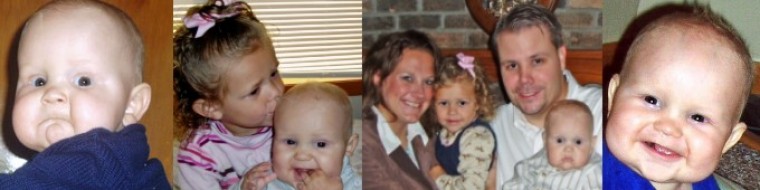
Gavin is doing great, he is flirting with all the nurses so is getting extra special attention (no one can believe those cheeks and that smile!) He ate like a horse this morning so that was really good and they are just monitoring his oxygen. We thought about removing the IV but since they have to go back in on Sunday they are just going to keep it in (we will be here, no early release, bummer). He gets another night off of dialysis to help him heal some and then he will start up again tomorrow night and Saturday before they go in again.
It’s amazing how when you are in that room your fight instinct just kicks in. We are all feeling strong, thanks so much for always being there to support us and him, it’s because we have such a wonderful support system that we can do this! Lauren has informed me that the manatee is a sea cow and is a little peeved mommy isn’t there at bed time so is making daddy read four stories instead of 2! Thanks mom, dad and T for spoiling her rotten while we are here! Keep up the good thoughts!
Gavin Surgery Complete…Will Need More Surgery On Sunday 11/19
Gavin is waking up from surgery and is doing well, a little sore as anticipated. They were not able to do all that they need to do so they are going to have to do another surgery on Sunday. It is unclear if he will have to be in the hospital until Sunday, they will have to see how he does tonight. Thanks for all the prayers and keep praying for Sunday! He was all smiles today and I can’t wait to hold my beautiful baby boy again!
Gavin Surgery Update @ 4:00 pm
Gavin still has about another hour left, but he went under well. Unfortunately they have not been able to do all that they need to do, so they will have to do another surgery in the next few days. We’re taking deep breaths and Gavin was smiling and laughing all day so he actually relaxed us (the irony!). Hopefully he will recover quickly and we can get out of here. The best part of going to Children’s is always leaving it! Thanks for the prayers!
Gavin’s Surgery Scheduled for 1:45 p.m. on 11/15
Gavin will undergo urological surgery tomorrow (Wednesday, November 15th) at Children’s Hospital in Milwaukee. The surgery will begin at 1:45 p.m. However, Jill and Jay have decided against the additional surgical procedure of a gtube placement, as the risks at this time are just too high. Gavin will need to be off dialysis for 2-3 days minimum to let himself heal so he will be monitored closely by doctors for his creatinine and urea levels. There are many risks for this necessary surgery, such as any type of infection, and especially peritonitis. At this time, Gavin will need to be in the hospital a minimum of 5 days for recovery.
Please keep the Schwalbach and Winslow families in your thoughts and prayers. We will keep you updated on any information we have regarding Gavin’s medical condition and recovery.
November 15th – Gavin Will Have Urological Surgery
Gavin is going in on November 15th to have urological surgery and have a gtube placement. He will need to be off dialysis for 2-3 days minimum to let himself heal so he will be monitored closely by doctors for his creatinine and urea levels. They are also concerned of peritonitis which would force him into hemodialysis which is NOT an ideal situation. Gavin is a trooper and we expect all good things from this little man, but all prayers and good thoughts will be appreciated!
About Peritoneal Dialysis
Gavin is on Continuous Cycler-Assisted Peritoneal Dialysis (CCPD) which first became practical and widely used for kidney failure since the 1980’s.
Gavin’s peritoneal dialysis (PD) treatment (which requires sterile technique meaning there is a scrub in time and surgical mask worn during this procedure) is performed every day at home by his parents using a machine called an automated cycler, which performs his exchanges (each cycle of draining and refilling is called an exchange) for ten hours during the night while he sleeps. PD must be performed everyday because fluid must be in his abdomen at all times to clean his blood adequately. Monitoring of his weight and vital signs is also done.
Gavin has a soft tube called a catheter, surgically placed in his abdomen (in the peritoneal cavity) that is used to fill his abdomen with a cleansing liquid called dialysis solution, and also used to carry the dialysis solution out of his abdomen. (Gavin’s catheter has merged with scar tissue created by this surgery and that is how it is kept in place.)
The walls of his abdominal cavity (and yours) are lined with a membrane called the peritoneum which allows waste products, (waste products, such as urea and creatinine, build up in the blood when kidneys fail) and extra fluid to pass from his blood into the dialysis solution the solution contains a sugar called dextrose, salt and other minerals dissolved in water, that pulls wastes and extra fluids from his blood into his abdominal cavity). These wastes and fluids then leave his body when the dialysis is drained, and the used solution, containing these extra fluids and wastes is thrown away.
The period his dialysis solution is in his abdomen is called the dwell time.
Currently, Gavin has ten exchanges a night, for ten hours, with a dwell time of one hour, using the 1.5 and 2.5 liter or combinations of the two, solutions. In the morning his last exchange uses the2.5L solution and his dwell contains 80 cc’s because it must last the entire day.
Sensors will trigger an alarm and shut off his machine if there’s a problem with his inflow or outflow. Because Gavin is drained by gravity, if the alarm goes off (which has happened, sometimes hourly, all night long) Gavin’s parents must come in and wake him up to fix the problem.
Some Complications of Peritoneal Dialysis:
Sometimes CCPD patients may have a solution absorption problem with the daytime exchange because of the long dwell time to remedy this an additional exchange is needed in the mid-afternoon to increase the amount of waste removed and to prevent excessive absorption of fluid (this hasn’t happened to Gavin yet – knock on wood.)
Infection of the peritoneum (peritonitis) abdominal infection – is the most common problem for people like Gavin who are on PD so Gavin’s mom and dad have to wash their hands every time they need to handle his catheter. They must also clean his exit site with antiseptic every day.
Developing diabetes mellitus (requires blood sugar monitoring) or obesity – this develops because of the large glucose (sugar) content of the peritoneal dialysis.
Anemia (low red blood cells) is common to people with kidney disease – Red blood cells (RBC’s) carry oxygen to cells throughout your body. Without oxygen, cells can’t use the energy from food –so- someone with anemia may tire easily and look pale. Anemia also contributes to heart problems.
Anemia is common because failed kidneys cannot produce the hormone erythropoietin (EPO), which stimulates the bone marrow to produce RBC’s. Fewer RBC’s means less oxygen =’s Anemia.
Gavin is anemic and receives EPO injections.
Renal Osteodystrophy (bone disease) affects up to 90% of dialysis patients. It causes bones to become thin, weak or malformed.
Itching (Pruritus) Itching can be made worse by uremic toxins (poisons) in the blood that dialysis doesn’t adequately remove.
Restless Leg Syndrome aching, uncomfortable, jittery or restless legs make kidney patients feel a strong impulse to kick or thrash their legs (theories about this include nerve damage and chemical imbalances.)
Sleeplessness which can lead to “day-night reversal” headache, depression and decreased alertness.
Vitamin and Mineral Deficiency – Gavin has this and receives supplements.
Hernias of the abdomen or groin – Gavin has this.
Hyperkalemia – high blood concentrations of potassium that can cause irregular heart beat and cardiac arrest – this makes diet especially important.
Pericarditis – inflammation of the sac surrounding the heart.
High Acidity of the Blood.
Heart Failure.
Uremic Encephalopathy – abnormal functioning of the brain.
Bleeding from the site where the catheter is inserted or within the abdomen.
Fluid Flow Blockage caused by blood clots.
Abscess formation caused by infections at the catheter site.
Abnormally low blood albumin.
Partial Intestinal Obstruction – caused by development of too much scar tissue within the peritoneum.
Very low thyroid hormone levels.
Hyperlipidemia – (excessive levels of certain fatty compounds in the blood.)
What is End-Stage Renal Failure?
- It is also known as Chronic Renal Failure or Kidney Failure.
- It is Gavin’s diagnosis.
- It means that Gavin’s kidneys don’t work.
- It is a serious condition that is long term, permanent, and will eventually result in death unless a kidney transplant is performed.
What do the kidneys do?
Their primary functions are to filter the blood and eliminate (excrete) metabolic waste products, excess water and electrolytes (such as potassium, sodium, glucose, bicarbonate – in other words, they regulate fluid balance in the body.
Additionally, many drugs are eliminated by the kidneys.
Kidneys also help regulate blood pressure by:
- excreting excess sodium – if too much sodium in the bloodstream your BP( blood pressure) increases
- secreting the enzyme renin (when BP falls below normal the kidneys secrete renin (renin-angiotensin-aldosterone system)
A person with kidney failure is less able to regulate BP and tends to have high BP .
Additionally, kidneys secrete the hormone erythropoietin – which stimulates the production of red blood cells (RBC’s) in the bone marrow and the bone marrow then releases the RBC’s into the bloodstream.
Kidneys (along with several other organ systems) regulate the growth and maintenance of healthy bones by regulating levels of calcium and phosphorous – minerals critical to bone health – they do this by converting inactive vitamin D to active vitamin D – (vitamin D is a type of hormone produced in the skin and present in many foods – “calcitriol†is the active form of vitamin D and it is the calcitriol that stimulates the absorption of calcium and phosphorous from the small intestine).
A note of human interest: on average, approximately one-fifth of your total blood supply, – 1.3 qt (1.2l) of blood – in your body passes through your healthy kidneys every minute.
 Save Baby Gavin